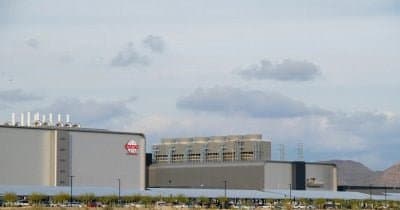
TSMC, the world's leading semiconductor manufacturer, has announced a staggering additional investment of $100 billion in its US operations, bringing its total commitment to a remarkable $265 billion.
This investment is largely funneled into a massive Arizona complex, which is set to host multiple fabrication plants, up to ten in total. With this latest financial commitment, TSMC is not only expanding its manufacturing capabilities but also solidifying its position as a critical player in both the tech and cryptocurrency sectors.
Investment Growth and Scale
Starting with an initial pledge of $65 billion, TSMC’s investment strategy has seen aggressive increments. The enhancement to $165 billion in March 2025, followed by the latest surge to $265 billion, highlights the company’s commitment to establishing a solid semiconductor presence in the United States.
This expansion includes plans for at least four new fabrication plants and two cutting-edge packaging facilities. The company has secured approximately 900 acres of land for this purpose, emphasizing the scale of its ambitions.
The Impact on the Crypto Ecosystem
TSMC’s output is crucial for the cryptocurrency industry, as it manufactures chips for companies like Nvidia, whose GPUs are essential in both AI training and cryptocurrency mining operations. Moreover, TSMC provides the advanced nodes necessary for ASICs that drive Bitcoin mining rigs produced by firms such as Bitmain and MicroBT.
During the chip shortages of 2021 and 2022, the crypto mining landscape faced significant challenges, with lead times extending and prices for mining equipment soaring. The geopolitical risks associated with Taiwan, a key center for semiconductor production, have underscored the urgency for US-based manufacturing.
Challenges Ahead
Despite the ambitious plans, the path forward is fraught with operational challenges. TSMC’s Arizona expansion has encountered hurdles such as construction delays and potential cultural clashes between Taiwanese management styles and American labor practices. The complexity of scaling operations to ten fabs in a foreign environment introduces a range of execution risks that investors should closely monitor.
This article is informational in nature and does not constitute financial advice.