Dell Technologies Inc. saw a significant drop of 14% in its stock price on July 15, triggered by a widespread selloff in the AI hardware market. This decline was steeper than that of competitors such as HPE and Super Micro Computer, highlighting Dell's vulnerability in the sector.
Key Market Movements
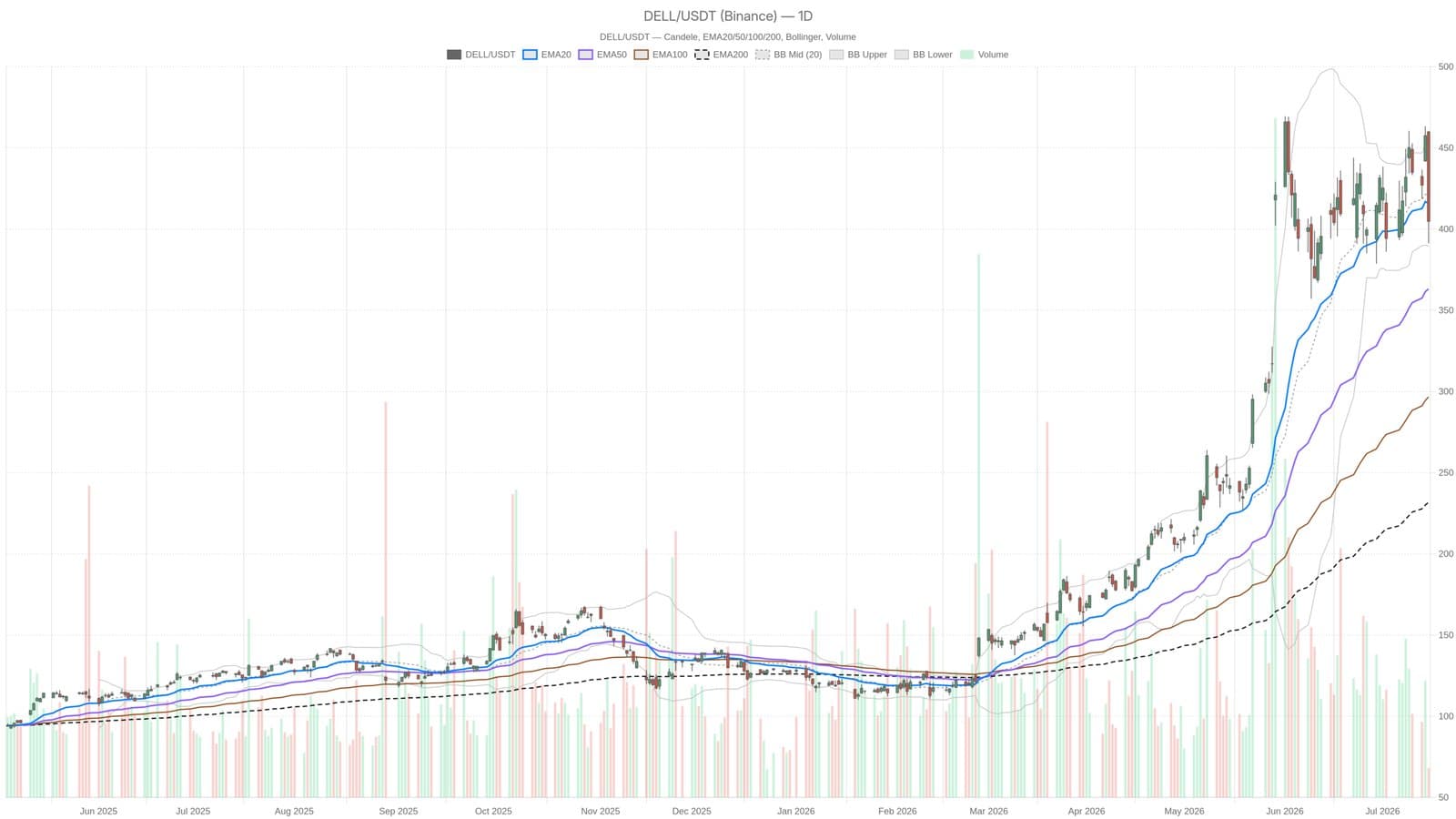
The stock closed at $404.79, slipping below its 20-day Exponential Moving Average (EMA) of $415.79. This shift indicates potential structural issues, yet analysts suggest that the overall trend might remain intact for the time being. The stock's daily movements showed a troubling range, with a high of $460.56 and a low of $391.33, marking almost $70 in fluctuation during the trading day.
Additionally, the daily Average True Range (ATR) confirmed heightened volatility, which was more than double the average daily movement. Traders are now closely monitoring whether the stock can break through the midline of the Bollinger Band, currently set at $421.19. If it continues to struggle, the bearish outlook could solidify.
Technical Analysis Insights
Despite the day’s sharp decline, long-term indicators such as the 50-day EMA at $363.18 and the 200-day EMA at $231.80 remain significantly below the current price, suggesting that the longer-term trend isn't in jeopardy just yet. However, with the stock firmly below the 20-day EMA, which has now turned into a resistance level, the pressure is mounting on Dell to reverse this trend quickly.
The ongoing concerns about memory pricing, highlighted by Evercore ISI on the same day, further exacerbate the pressures on Dell and its peers in the AI hardware space. As the market reacts to these developments, the next few trading sessions will be crucial for Dell's recovery prospects.
This material is for informational purposes only and does not constitute financial advice.