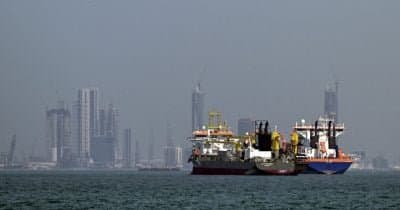
The Strait of Hormuz, a vital artery for global oil transport, has seen a staggering 52% reduction in vessel traffic as tensions between the US and Iran escalate. According to data from MarineTraffic, the number of ships crossing the strait plummeted from 37 to just 14 between July 10 and 12, 2026. This decline is a direct consequence of military hostilities that have escalated into strikes from both sides.
Current Situation in the Strait
The sharp drop in maritime traffic coincides with heightened military actions, wherein the US Central Command targeted Iranian shipping facilities in a series of strikes. In retaliation, Iran claims to have attacked two supertankers, further complicating the already tense situation. Shipping intelligence firms like Kpler and Windward report that many vessels are now avoiding the strait altogether, opting for alternative routes or going "dark" by turning off their transponders to evade detection.
The roots of the current crisis can be traced back to early 2026, when Iran began issuing threats to shut down the strait entirely. Following these threats, the Islamic Revolutionary Guard Corps (IRGC) launched a series of attacks on commercial vessels, effectively transforming one of the world’s most crucial oil channels into a toll road.
Bitcoin as a New Form of Toll Payment
Since March 2026, the IRGC has instituted a toll system for vessels using the strait, demanding payment in Bitcoin and stablecoins, with fees reportedly reaching $2 million per vessel. This marks a notable instance of a nation-state leveraging cryptocurrency under economic duress. Iran has even introduced a Bitcoin-backed insurance scheme for ships using these waters, establishing a financial ecosystem that operates independently of Western banking systems.
While on-chain analysis of Bitcoin transactions has shown limited evidence of large-scale settlements related to these tolls, the implications are significant. Payments might be obscured through privacy techniques or processed via intermediary wallets, suggesting that the volume of ships paying the toll could be minimal compared to those avoiding the strait.
Despite the turmoil, the wider cryptocurrency market has not yet reacted significantly. Historically, Bitcoin has fluctuated between acting as a safe haven or a risk asset during geopolitical uncertainties, and the current situation does not seem to have disrupted this trend.
This article is for informational purposes only and does not constitute financial advice.