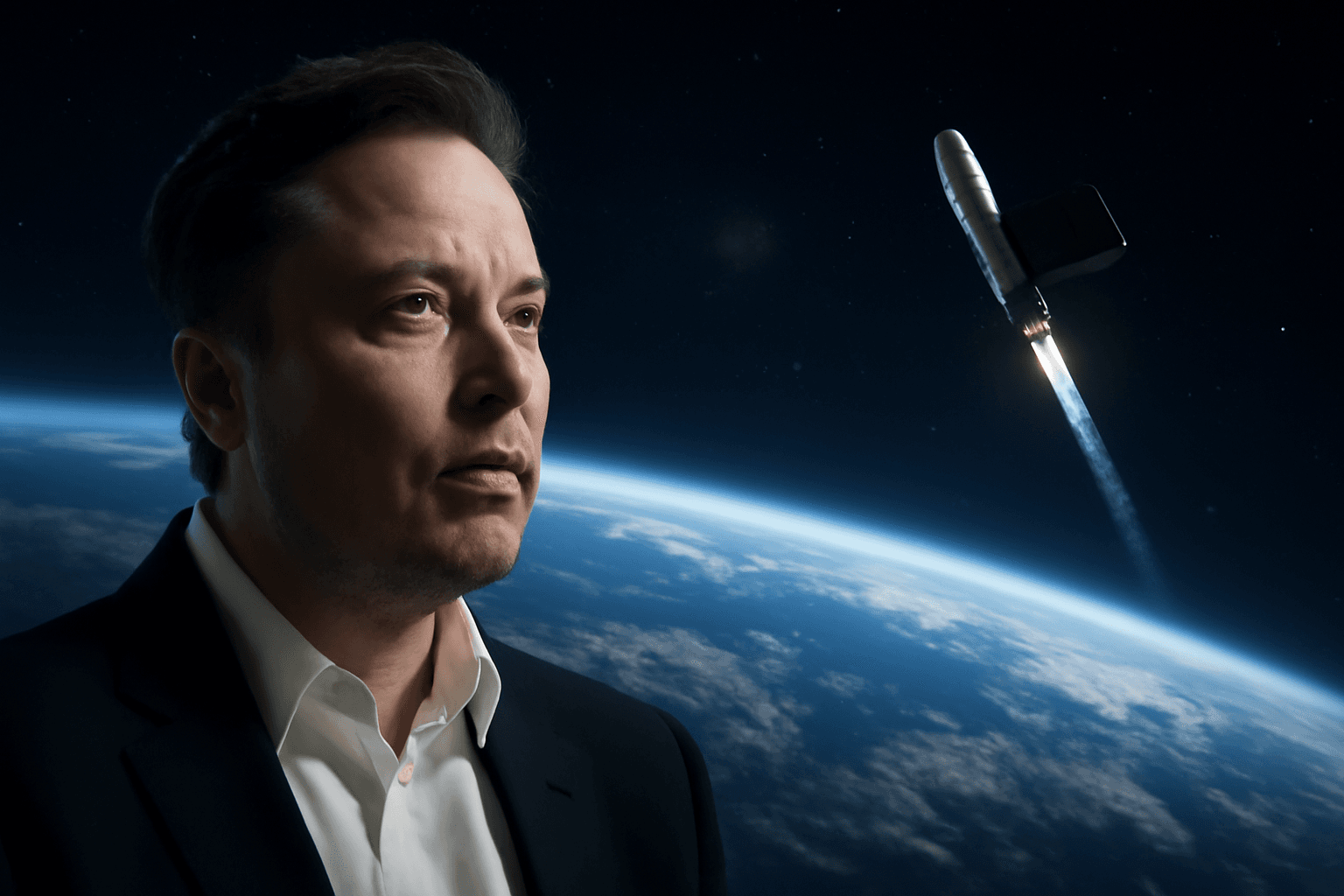
Elon Musk has reaffirmed his belief that the future of artificial intelligence (AI) infrastructure lies in space, as SpaceX sets its sights on achieving 1 gigawatt (GW) of computing power in orbit by 2027. This bold claim highlights Musk's vision of orbital data centers as a critical component in scaling AI capabilities.
Space-Based Computing: The Future of AI
Diving into the rationale, Musk argues that traditional terrestrial data centers face significant limitations. Power grids and land constraints hinder their expansion. In contrast, solar panels positioned in orbit can harness five times more energy than their ground-based counterparts, all while avoiding interruptions from nightfall or adverse weather conditions. “Space has the advantage that it’s always sunny,” Musk remarked recently.
SpaceX's Ambitious Plans
These comments come during a period of rapid development for SpaceX. The company recently unveiled its 11-million-square-foot Gigasat factory in Bastrop, Texas, designed for mass production of AI satellites starting in 2027. Musk's goal is to reach 1 GW of space-based AI computing by late 2027, with an ambitious aim of scaling up to 100 GW annually by 2030 and potentially even terawatt-level capacities down the line. However, he has advised investors to approach the timeline cautiously.
Shortly after the factory announcement, SpaceX introduced AI1, its first orbital data center satellite. This massive satellite measures approximately 70 meters across, surpassing the size of a Boeing 747, and can deliver an impressive compute capacity that averages 120 kilowatts (kW), with peaks reaching 150 kW. Musk indicated that AI1 is designed to be considerably simpler than their Starlink satellite.
Wall Street Buzz and Bitcoin Holdings
In addition to its ambitious technical projects, SpaceX's strategy reflects a considerable shift in the financial landscape. The company's recent public listing on Nasdaq raised around $75 billion, leading to a staggering valuation of $2.1 trillion and positioning Musk as the world’s first trillionaire.
SpaceX's prospectus emphasizes the growing demand for AI infrastructure, particularly due to the overburdened terrestrial power grids. Notably, the firm has also attracted significant interest from investors, including Cathie Wood's ARK, which acquired 3.3 million shares of SpaceX. Musk has hinted that the company could reach an astonishing $1 trillion in annual revenue by 2030.
Furthermore, SpaceX's involvement in cryptocurrency is significant, as it currently holds 18,712 bitcoins (BTC), underscoring its influence within the crypto market as well.